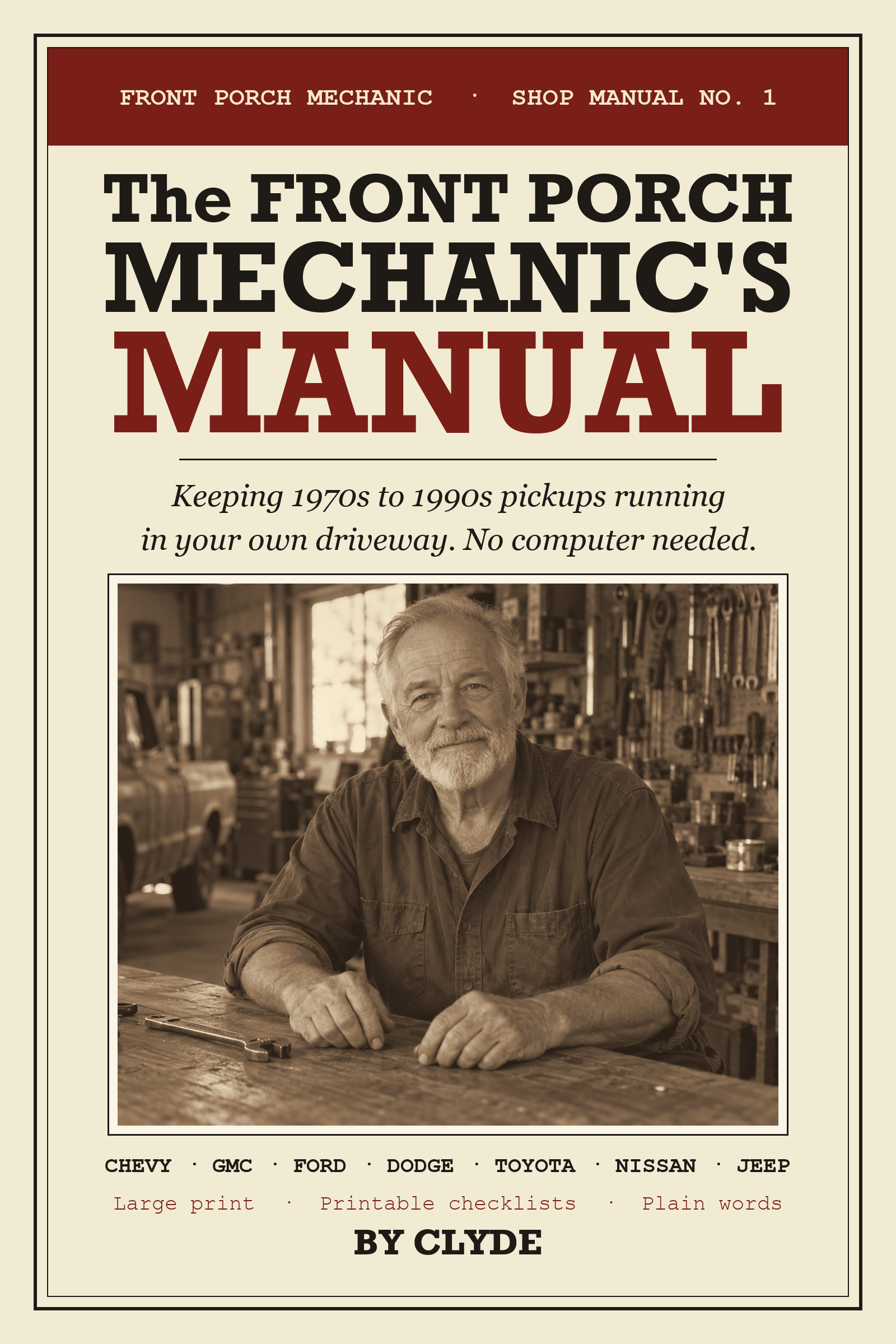
This manual shows you how to keep a 1970s to 1990s pickup running in your own driveway, with hand tools and the paper that came with your truck. No scan computer. No guessing.
You know this morning. The truck ran fine yesterday. Today a light comes on, the engine shakes at the stop sign, and you drive it to the dealer because you do not know what else to do.
A young man plugs a gray box under your dashboard. He walks back with a clipboard and a number circled in red. The diagnostic fee alone is often a hundred dollars or more, and nobody has opened the hood yet.
You stand there doing the math in your head. And the math is not kind.
Here is the part that stings. You used to fix your own truck. Your father fixed his. Somewhere along the way the engine went under plastic covers, the parts started hiding behind codes, and the man in the driveway got told to stay out.
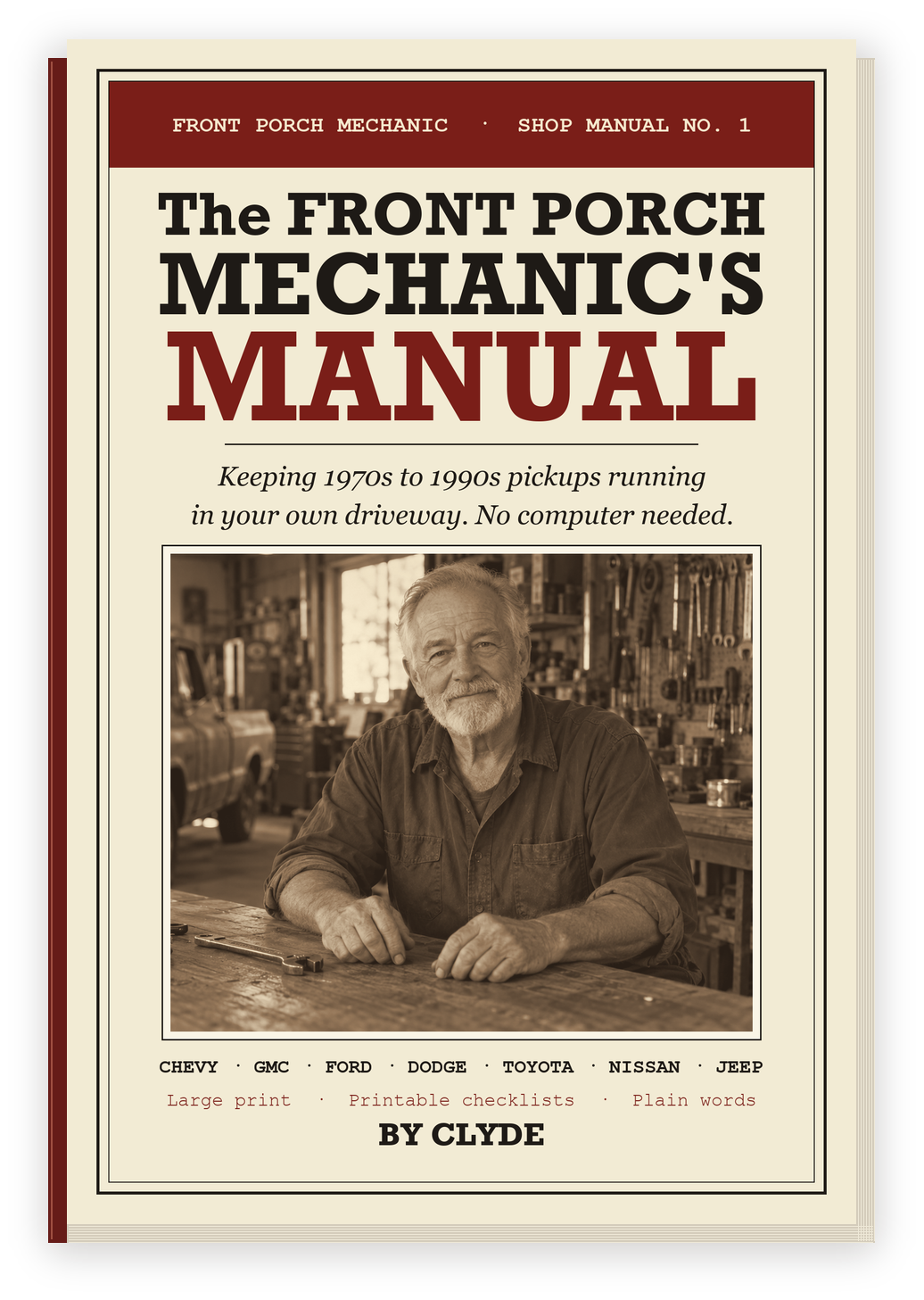
Federal rules made onboard diagnostics standard on cars and light trucks starting with the 1996 model year. A truck from before that line keeps most of its engine mechanical. The spark comes from a distributor you can open with a screwdriver. The tune-up numbers are printed on a label under your hood, because federal rules required that label too.
In other words, the instructions were bolted to the truck. This manual teaches you to read them, and what to do with them on a Saturday morning.

Sources inside the book: the federal onboard diagnostics rule (Federal Register, May 28, 1997) and the federal rule on the emission control label (40 CFR 86.095-35).
Picture a pickup that is six years old, pulling into a dealer lot on a Tuesday morning. It ran fine on Monday. Then a yellow light came on, and the engine shook at a stop sign.
The service writer plugs a small gray box into a port under the dash. He walks back with a clipboard and a number circled in red ink. The diagnostic fee comes first, and nobody has picked a wrench up yet.
How much is that fee? One public estimate puts a check engine light diagnosis at about $122 to $179 before taxes and fees, across many models. Then comes the part, behind a cover you cannot see, for a sensor you have never heard of.
That is a picture, not a claim about any real person. But if you have owned a newer truck, you have probably lived some version of it.
One rule matters more than every other rule in this chapter. Change one plug and one wire at a time. Never pull all the wires off at once.
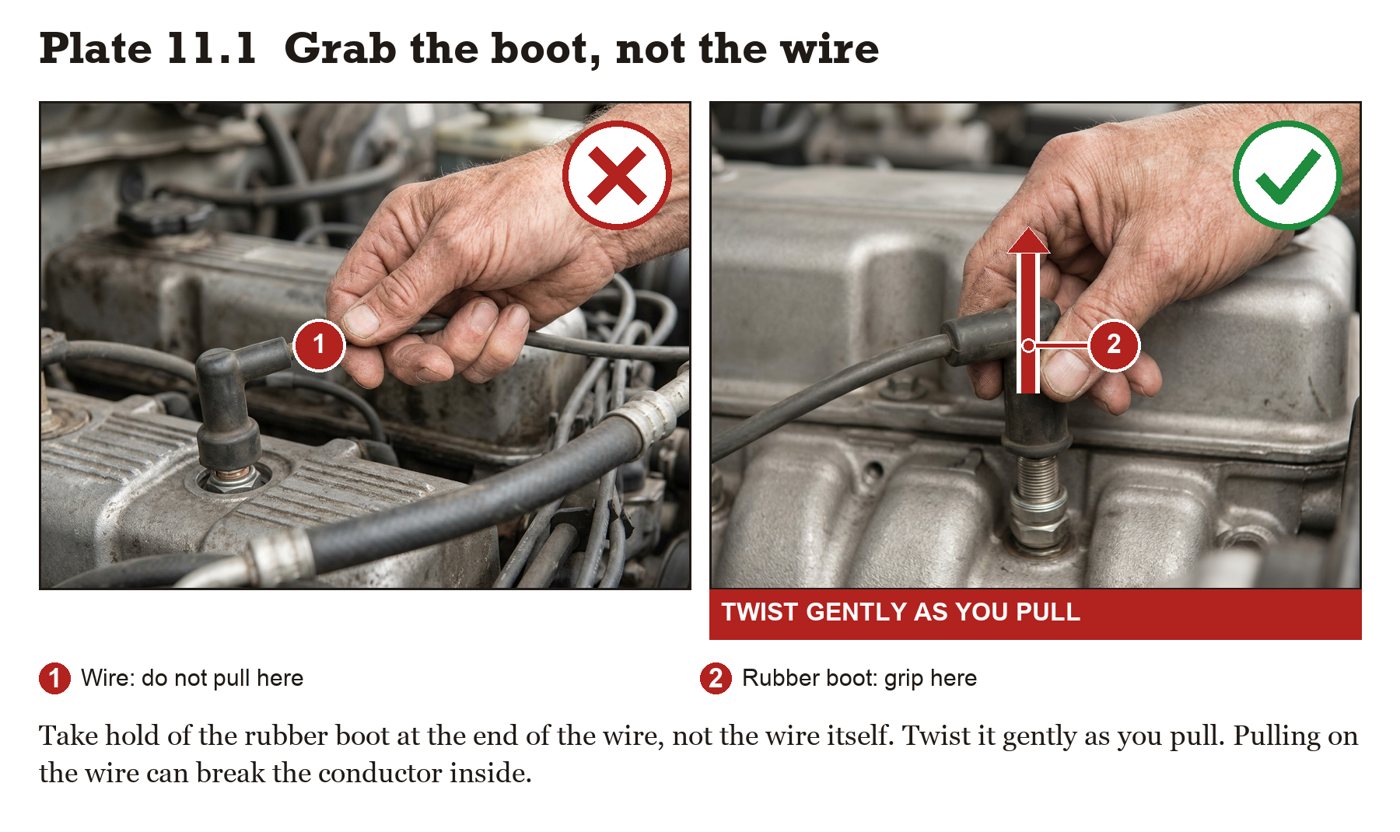
Take hold of the rubber boot at the end of the wire, not the wire itself. Twist it gently as you pull. Pulling on the wire can break the conductor inside, and then you have a miss that is hard to find.
Look at the end of the old plug before you throw it away. Set it on your clean rag or in your tray, in the same order it came out, so you know which cylinder each one came from.
If you see oil on the plug, or anything else that worries you, stop here and call a shop, and bring the old plugs along so they can see what you saw.
The state of California says the old standard is out of date. CalRecycle, the state's recycling agency, runs a campaign called "Check Your Number." Its page says the old standard of 3,000 miles is out of date, and that many cars can go 5,000 to 15,000 miles between changes. The page tells drivers to check the recommended interval in their owner's manual.
The filter makers say it depends on how you drive. A technical bulletin from the Filter Manufacturers Community, revised in 2013, says that for a number of years many new vehicle owner's manuals have recommended oil changes every 7,500 miles or 12 months or longer under "normal" service. For "severe" service, it says most owner's manuals recommend changing the oil every 3,000 miles with a new filter each time.
So the 3,000 mile number is real. It is the severe service number in many manuals. It is not a law of nature.
This is the part the clipboard hides.
A code tells you where the computer saw a problem. It does not tell you which part failed. One misfire code, for example, can come from a spark plug, an ignition coil, a fuel injector or a vacuum leak. The code is a starting point.
Do not walk into a parts store, hear a code and buy the first part on the screen. Store staff generally do not diagnose problems, and a store's own report says it does not replace a full mechanical inspection.
Major parts chains read codes for free on compatible vehicles. A motoring site reports that AutoZone, O'Reilly Auto Parts and Advance Auto Parts all offer a free scan. Someone, sometimes you, plugs a scanner into the port, usually under the dash near the driver's knees. The scanner pulls the stored codes, and the store prints a report with possible causes and fixes. AutoZone says the scan can take less than a minute.
| At the shop | In your driveway, with this manual |
|---|---|
| A check engine light diagnosis: about $122 to $179 before taxes and fees, in one public estimate, before any repair | On a pre-1996 truck there is no port to read. You start with the label and your own eyes. Free. |
| A tune-up done for you, at shop labor rates | Spark plugs, a distributor cap and rotor (kits listed at about $25 to $43 for a 1975 to 1986 C10) and an air filter, done on a Saturday morning. |
| A diagnostic fee on every warning light, for as long as you own the truck | The book is $27, once. It stays in your glove box. |
Every price comes from a public source listed in the book (63 sources). Check your local parts store for today's price.
I am a digital version of myself, made for the Front Porch Mechanic channel, so I can teach without the retakes. Everything in this book comes from what I learned and from the paper itself: the labels, the owner's manuals, the factory service manuals and the public records. Every number has its source in the back of the book.
I wrote it for the man who still has the truck. The one that is paid off. The one you can hear coming down the road. It deserves better than a code reader and a clipboard, and so do you.
Where a job is not safe for a driveway, I say so, and I tell you when to stop and call a shop. Brakes, steering, airbags and the fuel system are shop jobs. This book will never pretend otherwise.
30-day money back. If it does not help you with your truck, write and you get every cent back, and you keep the bonuses.
The seven trucks of Part II have their own chapters. The method of the book (read the label, the owner's manual and the factory service manual, then do the job) works on most carbureted and early fuel-injected pickups from the 1970s to the 1990s. Chapter 18 covers 1996 and newer trucks with a check engine light.
Yes. It starts with the paper and the tools, and every job is in numbered steps with the moment to stop and call a shop.
It is set in large print, and you can zoom on a phone or print it on plain paper.
It covers only jobs that are reasonable in a driveway, with the safety rules first. It never covers brakes, steering, airbags, the fuel system or high voltage, and it is general information, not professional mechanical advice.
No. It is a PDF you download right after you pay, so you can start this weekend.
Write within 30 days and you get your money back. No questions. You keep the bonuses.